Radar Repeater Serial Number
By Muhammad Khalid Hussain; published ; updated
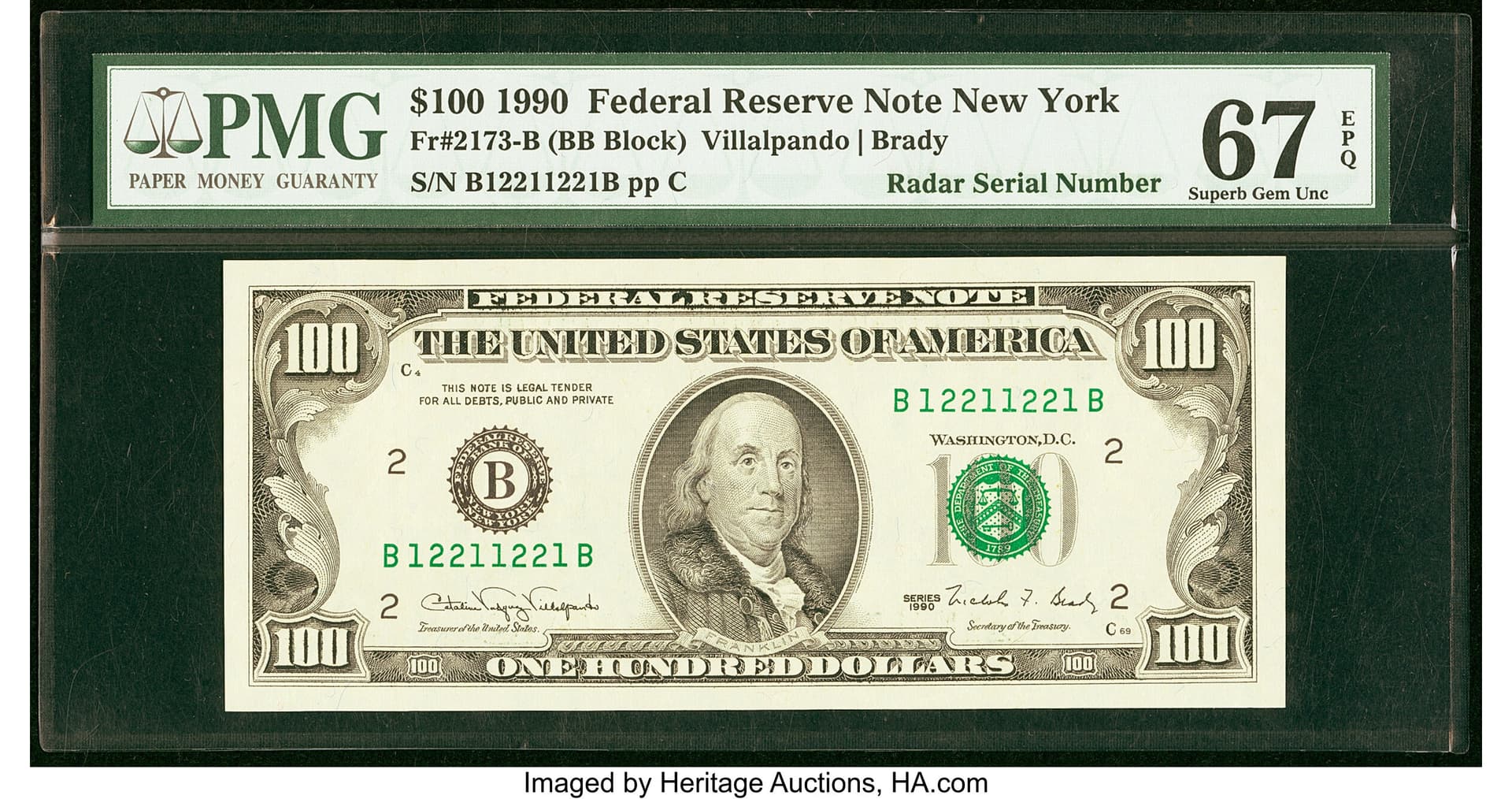
A radar repeater serial number repeats a four-digit radar block: ABBAABBA, as in 12211221. Banknote Expert checks all eight digits, including any leading zeros, to distinguish this overlap from a plain radar or repeater.
Enter your bill’s 8-digit serial number above to see its rarity score, any matched patterns and an estimated value range. Nothing is uploaded. The check runs entirely in your browser.
What is a radar repeater?
A radar repeater is an eight-digit serial whose first four digits repeat as the last four, while that four-digit block is itself a radar. The shape is ABBAABBA: 1221 reads the same backward and repeats to make 12211221. Some sellers call these repeater radars; the order of the words does not change the digit test.
The checker evaluates the eight digits between the letters. A leading zero remains part of the serial. A star replacing the final letter marks a separate feature, not a change to the radar repeater rule.
Radar repeater vs radar vs repeater
A radar is any eight-digit palindrome, such as 12344321. A four-digit repeater copies positions one through four into positions five through eight, such as 12341234. A radar repeater does both because its repeating block has the ABBA shape. This is why every radar repeater also qualifies as a radar and repeater, while the reverse is not generally true.
See the radar serial number guide and the repeater pattern on the fancy serial hub for the broader rules. A super radar instead requires six identical middle digits.
| Feature | Radar | Repeater | Radar Repeater |
|---|---|---|---|
| Rule | Eight digits read the same backward | First four digits repeat | Both rules; repeated block is ABBA |
| Example | 12344321 | 12341234 | 12211221 |
| Checker relationship | Broader palindrome | Broader repetition | Specific overlap |
Radar repeater examples and non-examples
Treat each example as an eight-character digit string. The detector can recognize overlapping shapes even when the checker gives a more specific pattern the primary label.
A full serial such as A12211221* has the same eight-digit radar repeater shape as 12211221, plus a star suffix. The star does not make the digit pattern rarer by itself; check its print run separately.
| Serial | Result |
|---|---|
| 12211221 | Radar repeater: 1221 is a radar and repeats |
| 25522552 | Radar repeater: 2552 repeats |
| 01100110 | True Binary Repeater priority; raw radar repeater rule also matches |
| 10011001 | True Binary Repeater priority; also a binary radar and raw radar repeater |
| 11111111 | Solid: raw radar repeater rule matches, but checker shows Solid |
| 12344321 | Radar only: the first four do not repeat |
| 12341234 | Repeater only: 1234 is not a radar |
| 12211222 | Neither: final block differs |
How rare is a radar repeater?
The detector requires a repeated ABBA block. Choose A in 10 ways and B in 10 ways. That gives 100 matching strings out of 100,000,000 possible eight-digit strings, or 1 in 1,000,000 for the literal rule. Ten choices have A equal to B and are solids. For the distinct-digit radar repeater shape collectors usually mean, choose A in 10 ways and a different B in 9 ways: 90 strings, about 1 in 1,111,111. The pattern card rounds this to 1 in 1,100,000.
Two of the 90 non-solid strings use only 0 and 1. Those also meet the site's True Binary Repeater rule, which has higher checker priority. These are mathematical string odds, not a count of surviving notes or a promise of market demand.
How much is a radar repeater worth?
The site's verified value-band data has no publishable radar repeater sold-price range for Circulated, Very Fine, or Uncirculated notes. The blank cells below mean there is no qualifying recorded sale band, not that the note has no value. Generic radar or repeater sales cannot be relabeled as radar repeater sales.
For how condition and comparable sales affect radar serial number value, read the fancy serial number value guide. Compare completed sales for the same denomination, grade, and pattern before estimating your own radar repeater note value.
| Condition | Recorded range | Sample |
|---|---|---|
| Circulated | ||
| Very Fine | ||
| Uncirculated |
What moves the value?
- Grade and eye appeal matter. Folds, writing, stains, and handling make a worn note a poor comparison for an uncirculated example.
- Denomination changes the face-value floor and the pool of comparable buyers. Compare bills of the same denomination where possible.
- Pattern overlaps can attract attention. The 10011001 shape is also a binary radar and true binary repeater; the checker may show the more specific primary label.
- Digit appeal varies by collector. Repeating 7s or 8s may be preferred by some buyers, but no fixed extra dollar amount follows from the digits alone.
- A star suffix can add a separate scarcity question. Its print run and condition need their own checks, and no verified band isolates a radar repeater star-note premium.
Compare the binary guide and use the star note lookup for those overlaps. A ladder radar claim still needs both exact detector rules; a visually tidy sequence alone is not enough.
Should you grade or sell it?
Keep a radar repeater dollar bill if you enjoy the pattern. If you plan to sell, inspect completed sales for notes with the same denomination and likely condition, then subtract fees, postage, and your time. An asking price is not a sale.
Grading can make sense for an unusually clean note or a strong combination when comparable sales support the fee. With no dedicated sold-price band, do not assume the radar repeater label alone will recover grading costs. A worn bill with only a partial pattern may be worth spending.
How to check your serial
Copy all eight digits, preserving leading zeros. Confirm positions one to four equal positions five to eight, then check that the first and fourth digits of that block match and its second and third digits match. Add any prefix and final letter or star when using the checker so it can show the note context too.
Use the fancy serial number checker to see the primary label and any other recognized patterns.
Check your serial on Banknote Expert
Enter all eight digits, including leading zeros, to check the radar repeater rule and other matching patterns.
Open the fancy serial checkerRadar repeater serial number FAQs
What is a radar serial number?
A radar is an eight-digit serial that reads the same forward and backward, such as 12344321. It does not need to repeat its first four digits.
What is a radar repeater?
It repeats a four-digit radar block in the ABBAABBA shape, such as 12211221. A repeater radar means the same digit arrangement here; collectors may also say repeater radars.
How much is a radar repeater worth?
There is no publishable radar repeater sold-price band in the site's verified data for any of the three condition groups. Compare completed sales of like notes before putting a price on yours.
How do you identify a radar/repeater?
Check that the last four digits copy the first four and that the first four read the same backward. Keep all eight digits, including leading zeros.
How rare is a radar repeater?
The raw rule matches 100 of 100,000,000 eight-digit strings, or 1 in 1,000,000. Removing 10 solids leaves 90 non-solid patterns, about 1 in 1,111,111.
What is the difference between a radar and a repeater?
A radar is a full eight-digit palindrome. A repeater copies the first four digits as the last four. A radar repeater satisfies both tests.
What is a super radar vs a radar repeater?
A super radar has six identical inner digits, as in 17777771. A radar repeater has a mirrored four-digit block repeated twice, as in 12211221. Both read the same backward, but their extra rules differ.